Otto Friedrich Thienemann
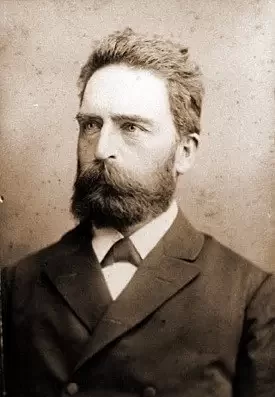
* August 11, 1827 (Gotha) – November 28, 1905 (Vienna)
Otto Thienemann was a leading Viennese architect and court designer of important buildings in Nový Jičín at the end of the 19th century. He came from a family of lawyers and booksellers. Between 1844 and 1848, the young Otto Thienemann studied at the Vienna University of Technology, the Vienna Academy of Fine Arts, and the Academy of Architecture in Berlin. Unfortunately, his education was partially influenced by the revolutionary year of 1848.
In 1865, he began his own private career as an architect in Vienna. From 1868, he worked as the chief architect for the Crown Prince Rudolf Railway (k.k. priv. Kronprinz Rudolf-Bahn Gesellschaft). He won second prize in the competition for the construction of the new Vienna City Hall. He became the imperial and royal city architect of Vienna and the imperial and royal building councilor. In 1873, he was invited to participate in the competition for the House of Artists (Rudolfinum) in Prague. In 1874, he became director of the Austrian Military Building Association.
In 1875, architect Otto Thienemann was awarded the Austrian Gold Cross of Merit, in 1887 he became a building councilor, and in the same year he was knighted by the Austrian Imperial Order of Franz Joseph.
As a private architect, Otto Thienemann participated in the design of private villas and houses for the upper classes, as well as schools, association buildings, and Protestant church buildings.
1880–1882
The villas of August and Johanna Hückl in Nový Jičín